
Notes from The Writer's Corner
This week, Jeffrey Yamaguchi on building a platform. Next week, First Lines: Crafting an Opening That Hooks. And tips on nurturing your writing life.

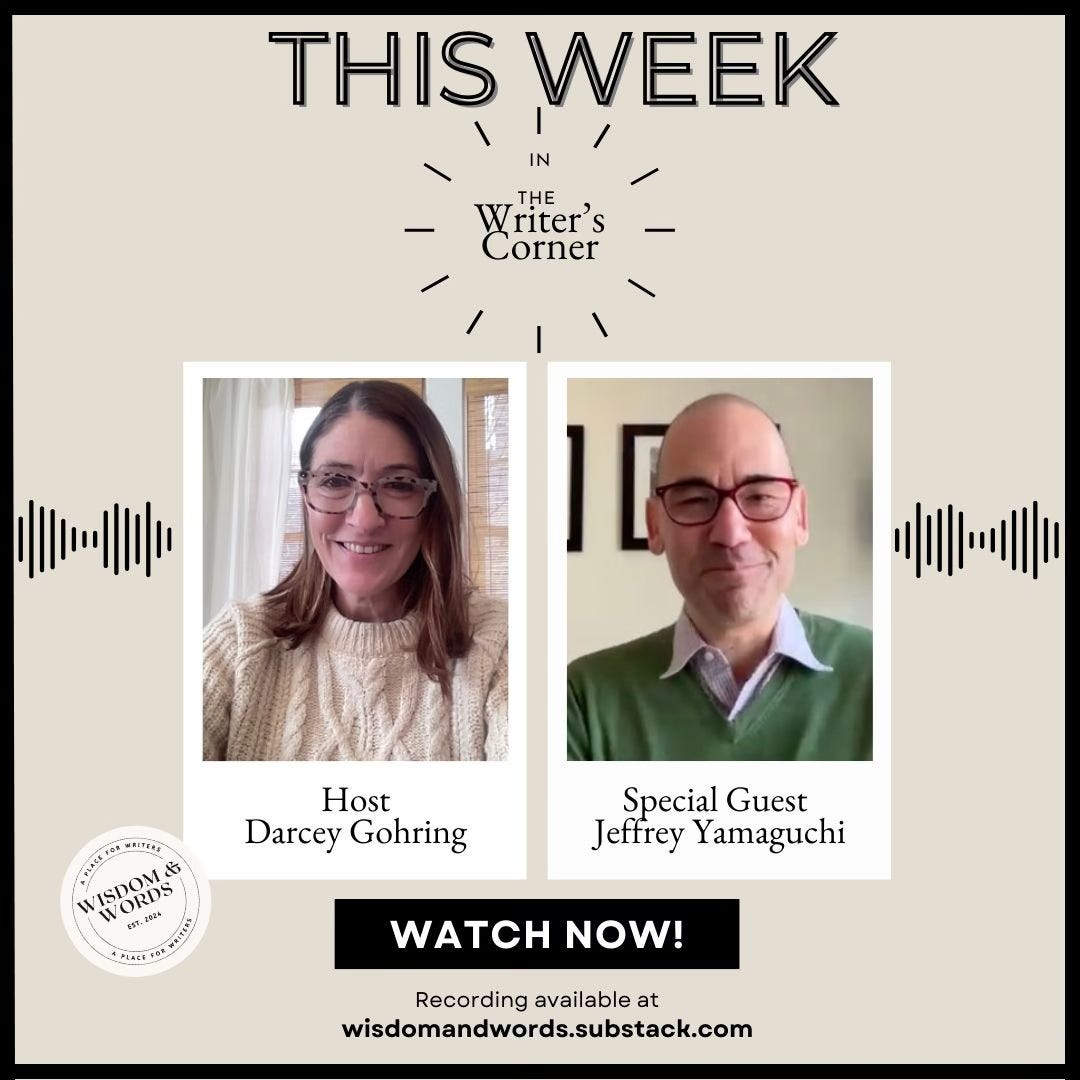
This week, publishing professional Jeffrey Yamaguchi joined us to share how writers can thoughtfully build their platform and promote their work with authenticity.
A few key takeaways from this discussion:
• How to make a platform that is less about self-promotion and more about sustained connection
• Why writers don’t need to be everywhere, but they do need to be intentional where they are and how they show up
• How to build visibility without turning yourself into a full-time marketer
• And much more!
Jeffrey’s Substack is called Book Publishing Brick by Brick. It has great information (especially if you fall into any of the following categories: are writing your first book, are working to land an agent, are planning your book’s launch campaign, are self-publishing a book, or are an established author). Click HERE to check it out and subscribe.
To learn more about Jeffrey’s work and the services he offers, visit his website HERE.
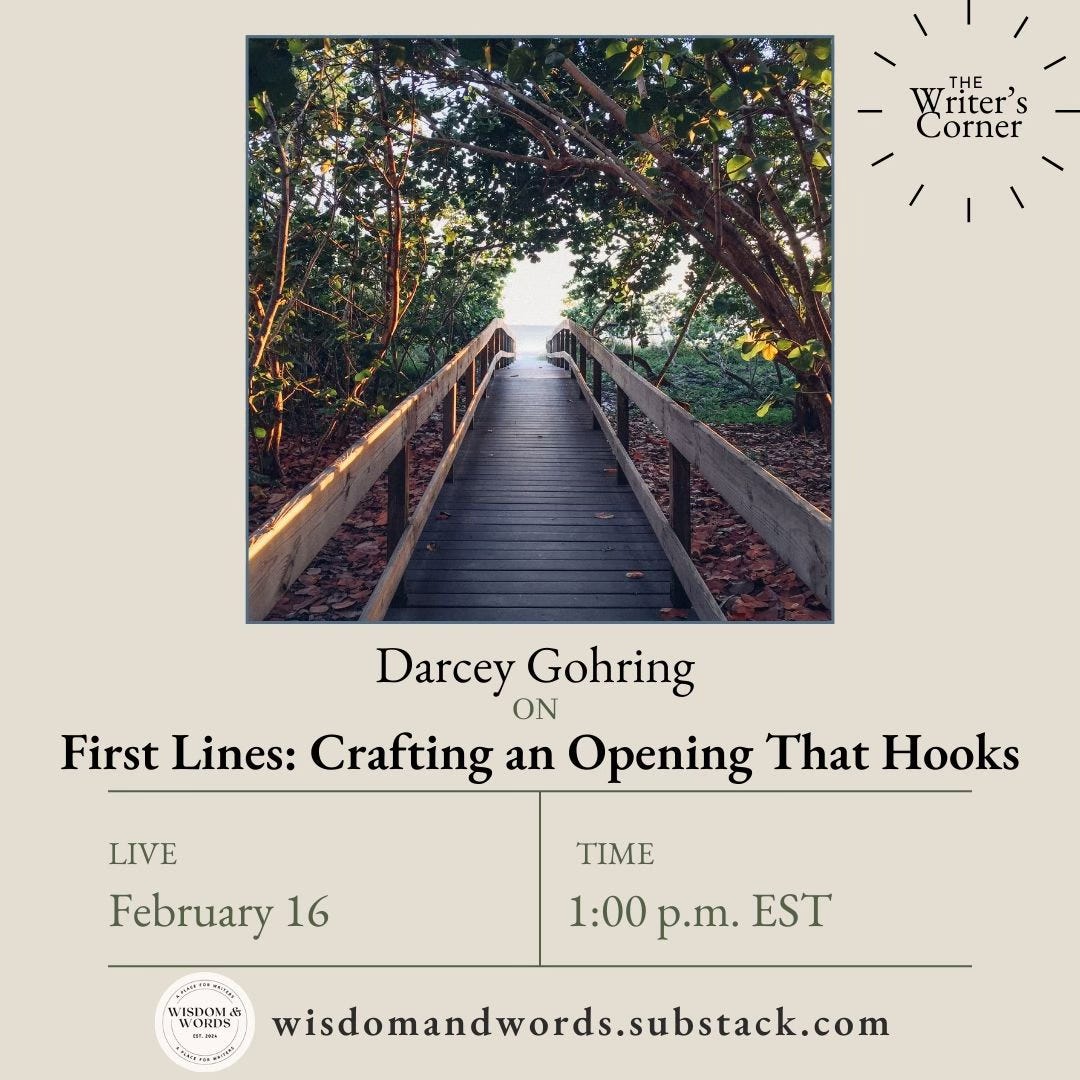
February 16 at 1 p.m. EST/10 a.m. PST
First Lines: Crafting an Opening That Hooks
Next week, I’ll be leading a craft-focused session on writing compelling beginnings. We’ll discuss what hooks a reader, common missteps in early drafts, and how moving scenes or restructuring your opening can elevate the entire piece. If you’ve ever struggled with where to start or how to rearrange your material to better hook a reader, this one’s for you.
Note: This session is free for all live attendees. A recording will be available to paid subscribers.
Food for thought …

Staying With the Work: Even When It Gets Hard
If you are serious about writing, your relationship to the craft is something that needs to be continuously fostered and protected.
That means sticking with it through the ups and downs.
Most writing advice focuses on starting: brainstorming ideas, building habits, and pushing through first drafts. (Aka - the part of the process that is filled with excitement.)
But the truth is, most projects don’t fail at the beginning.
They fail after the first rush of inspiration fades and you’re … halfway through your first draft, in the messy middle, revising, or struggling with rejection.
Let’s take a look at a few places where projects fall apart and how to reframe before that happens:
Early drafts are often messy and incomplete. This is not because the writer is doing anything wrong, but because the work is still becoming itself. First drafts are for discovery—the writer is finding their way into the story. Staying with the work during drafting means allowing yourself to write a shitty first draft without panicking. It means continuing on even when you don’t fully understand the shape of the thing yet. Remind yourself: The draft doesn’t need to be perfect; it just needs to be finished enough to revise.
In the revision phase, initial excitement may have faded. Now it’s time to give the work a harder look. That might mean … cutting passages you loved, rethinking structure, getting feedback, and letting go of an early vision. In other words, it requires flexibility. Staying with the work in revision means resisting the urge to start something new just to feel competent again or giving up altogether because you can’t see the end yet. Although many times revision is seen as a slog, I think it is one of the most exciting phases of the process. It is when the real craft of writing takes place. How will you shape the work? How will you mold it?
By the time work is submitted, queried, or pitched, it has been shaped, refined, and workshopped. There is that hopeful moment (what if they say yes?!) and then … “Although we liked a lot about XYZ, your submission isn’t right for us at this time.” Rejection tests a writer. It can feel like a verdict not just on the project but on you. But it is also something every writer will experience at some point. Staying with the work after rejection doesn’t mean denying the disappointment, but it does mean not letting one (or many) rejection(s) decide the work’s worth. A project that has been rejected is not a project that has failed. It might just be a project that is still looking to find its way into the right hands. It also might be a good tool to reevaluate if the work is really ready yet or if it still needs refining.
Such a great conversation - Darcey and Jeff - many things that I've read in Jeff's newsletter, and things we talked about when we were working together last year. So much of it is evergreen advice that I'm still using as I'm gearing up for my next book. Thanks for the refresher!
Really enjoyed this Zoom! So many good topics covered!