
Notes from The Writer's Corner
Our deep dive into essay writing with Lisa McCarty. Next week: Jeffrey Yamaguchi on what happens after you type “The End.” Plus, one tip every writer should follow before hitting submit.

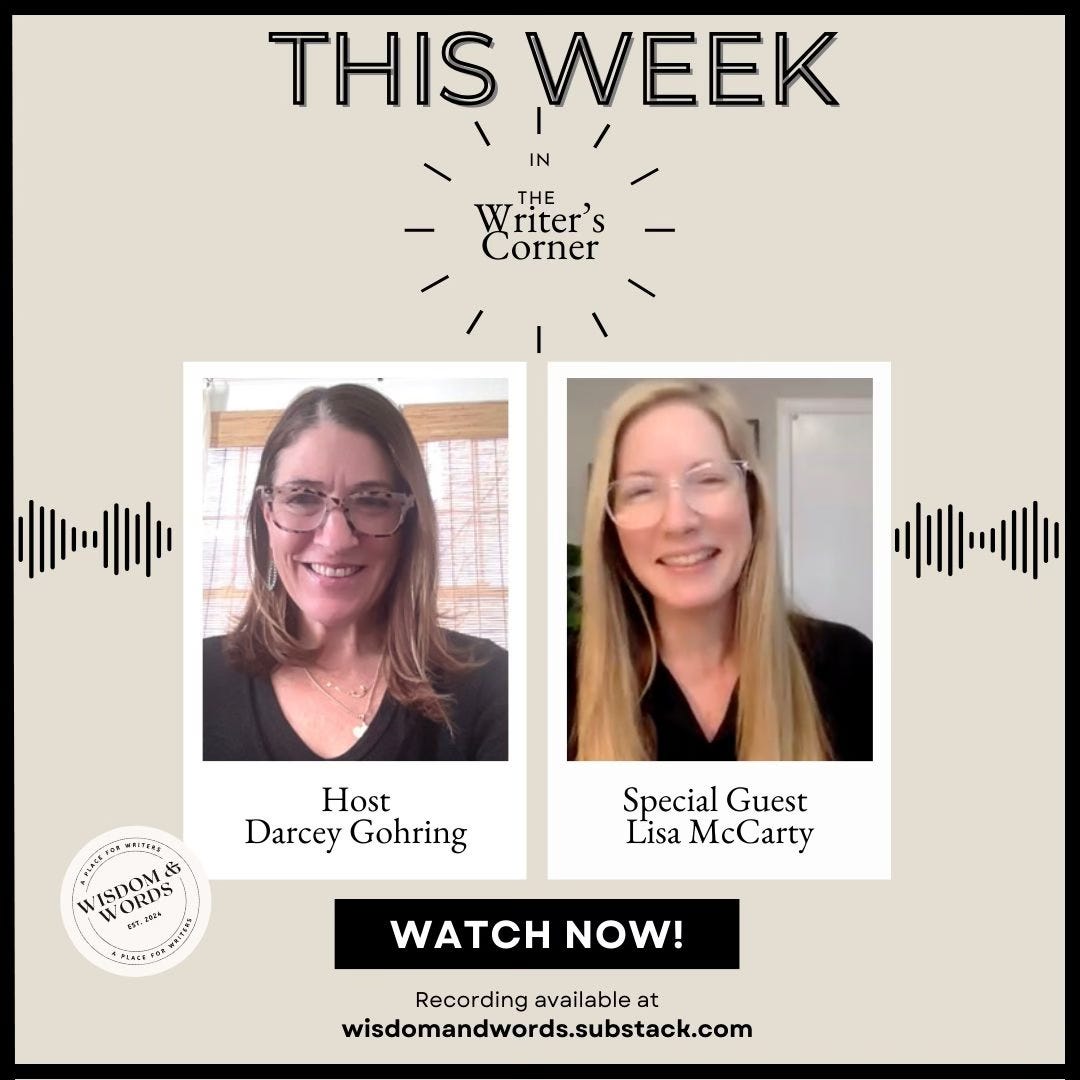
This week, we spoke with journalist Lisa McCarty for a deep dive into essay writing. If you’re writing in this genre now, or think you might soon, don’t miss this one!
A few key takeaways from this discussion:
• Why revision is where an essay finds its shape, voice, and authority
• How distance from a topic clarifies meaning (without dulling emotional truth)
• The key differences between personal and reported essays
• How Lisa decided one essay was the right topic for a full-length book project
• And much more!
To read some of Lisa’s work, click HERE. To follow her on Instagram, click HERE.
Next week …

February 9 at 1 p.m. EST/10 a.m. PST
Jeffrey Yamaguchi on What Happens After You Type “The End”
Jeffrey Yamaguchi has seen publishing from the inside and the outside—as a writer, and as a publishing professional at some of the industry’s biggest houses.
In this session, we’ll talk about what happens after creative work leaves your hands, and how to stay thoughtful about audience, visibility, and longevity while still protecting the heart of the work.
Jeffrey Yamaguchi (jeffreyyamaguchi.com) is an author and longtime book publishing professional who has held leadership positions at publishers such as Penguin Random House, HarperCollins, Abrams Books, and Blackstone Publishing. Currently, he works directly with authors and publishers as an independent marketing and publicity consultant to successfully launch their books, and publishes a well-regarded book publishing-focused newsletter: bookpublishing.substack.com. He’s also the author of several books (independently and traditionally published), and his poems, stories, and photography have been featured in numerous literary journals, including Black Bough Poetry, The Storms, The Hyacinth Review, Feral Journal, Boats Against the Current, and Atticus Review. His flash fiction piece “Last Day Cupcakes'' — published at Okay Donkey — was longlisted for the Wigleaf Top 50 and selected for publication in the Best Small Fictions 2024 anthology.
Food for thought …
Write Messy, Edit Accurately
Here’s the thing: a lot of writing gets published these days without formal fact-checking. That’s why I always recommend doing a careful check of your own work before you press submit.
A little backstory …
My first job in publishing was in the ’90s as a fact checker. I worked with a team, and the process was painstaking: highlight every fact in yellow. Then came the research: phone calls, first-person verification, whatever it took. Facts that checked out got swiped in green; mistakes got pink, with corrections added. Depending on the article, this could take anywhere from a few days to a week. (Can you imagine that in today’s world of social media and the internet?)
I can’t tell you how many articles I fact-checked in all, but I can tell you this. Every single one was by a respected journalist, and I always found at least one mistake.
That job taught me two things:
Even the most careful writers make mistakes
Always give your work a final fact-check before hitting submit
Most mistakes in writing aren’t about the big, dramatic plot points. It’s usually the small stuff: dates, ages, or a single detail within something larger.
Whether it’s fiction or non-fiction that could look like … a character is behind the wheel before they’re even old enough to have a permit … it’s snowing in a month where that city is usually hitting 60 degrees … you reference a song that wasn’t out the year the story is taking place … you had a character’s eyes as blue in one scene and brown nine chapters later … you said someone you interviewed was named Darcy but it’s actually Darcey with an e.
The good news is you don’t need to worry about fact-checking while you’re in the middle of drafting. It’s perfectly fine to let that first version be messy. But before you consider the manuscript truly finished, take a moment to slow down and verify the specifics—things like dates, distances, ages, and timelines. Think of this final pass as an act of respect for your reader, your story, and the world you’ve invited us to believe in.
Put simply: memoirs need to be believable, and fiction needs to feel like it could happen. What you don’t want is a reader catching a silly mistake and questioning everything else you’ve written. When the details are solid, your deeper themes can really land.
Great conversation with Lisa — truly appreciated the insights she shared about developing and placing essays. And can't wait to join the Writer's Corner on Monday to share info about building out a creative author/writer platform!
Great interview! Lisa is an amazing writer, friend and advocate.