
Notes from the Writer's Corner
Watch the replay with Christina Baker Kline, join us next week for our monthly Writer’s Session, and explore how to weave backstory into your work.

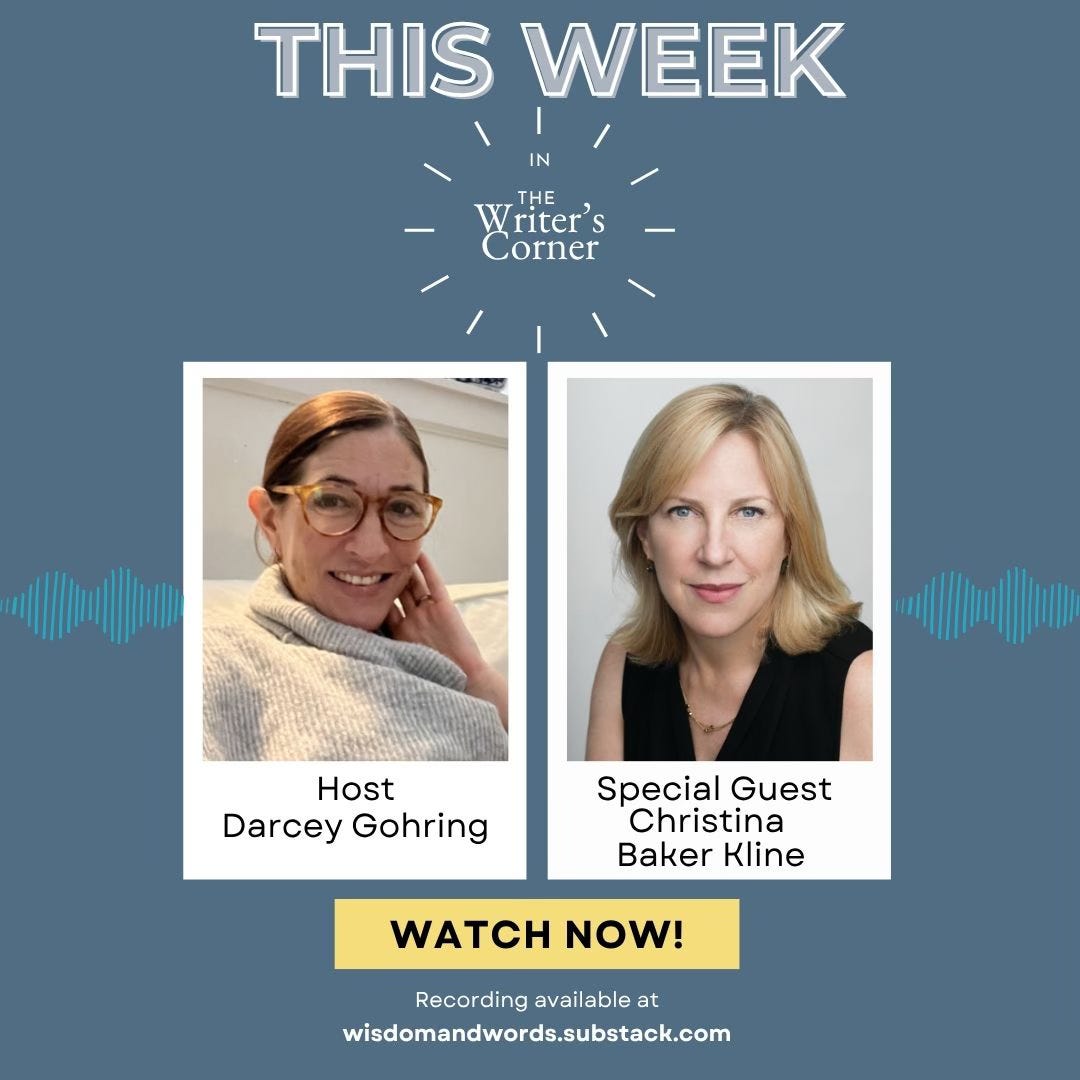
This week in The Writer’s Corner, we welcomed Christina Baker Kline, the #1 New York Times bestselling author of ten novels, for a conversation about her writing process, the lessons she’s learned throughout her career, and advice every writer needs to hear.
A few key takeaways from this discussion:
• How Christina found inspiration for her new novel in her own family history
• The architecture of building a story
• Writing dialogue that feels contemporary, even in stories set in the past
• How to embrace editing instead of resisting it
• And more!
Christina’s new book THE FOURSOME comes out on May 12! Pre-order a copy or learn more by clicking on the cover below.

Christina also told us about a retreat she’s hosting in Scotland in June of 2027. It sounds incredible. Click below for details.

Next week …

May 11 at 1 p.m. EST/10 a.m. PST
The Writer’s Session: An Open Exchange
Our monthly session devoted to community members. Join us for The Writer’s Session: An Open Exchange. No guest—just one hour to discuss the stamina of the creative life and craft. Bring a question, a hurdle, or a recent win you’re proud of.
Just a reminder that our open discussion sessions are not recorded because we want them to be a safe space for honest conversation.
Hope to see you there!
Food for Thought …
Backstory: Purpose and Placement
What Backstory Is (and Isn’t)
• Backstory provides the emotional or factual history necessary for readers to understand the present-day narrative.
• It is not a full life chronology, a detour, or a pause for explanation.
• It is a strategic release of information that adds depth, context, and emotional stakes.
Why Backstory is Needed
• It helps readers understand the experiences that shaped the narrator.
• It creates emotional logic: “Oh, now I understand why she reacted that way.”
• It builds tension by gradually revealing what the narrator once believed vs. what she knows now.
• It allows the writer to show transformation through contrast.
When to Add Backstory
• When the reader needs context to understand a decision, emotion, or reaction.
• When a detail from the past heightens the stakes of the present.
• After a compelling scene, to deepen meaning without breaking momentum.
Backstory should answer the question: “Why does this moment matter?”
How to Integrate Backstory Seamlessly
• Use “triggers” within the scene - A smell, sound, object, or gesture can move the narrator naturally into memory.
• Keep it brief and purposeful.
• Anchor readers in time. Use clear shifts so they never wonder: Where are we now?
Common Pitfalls
• Dumping too early: Let the present action hook readers first.
• Taking the reader too far out of the now.
• Giving the reader backstory that the writer may need to know but the reader doesn’t (if it doesn’t serve the story, cut it).
Takeaway
Backstory isn’t the main POV character’s life story; it’s only the part of your history that is relevant to the story you are telling today. Give readers just enough to deepen the “present,” clarify the stakes, and reveal who the narrator was before becoming who he/she is now.
Example
In Educated by Tara Westover, the backstory about her father’s survivalist beliefs is woven in small, vivid pieces.
Let’s take a look at an excerpt:
From Educated by Tara Westover
The first time mother assisted with a birth she was gone for two days. Then she wafted through the back door, so pale she seemed translucent, and drifted to the couch, where she stayed, trembling. “It was awful,” she whispered. “Even Judy said she was scared.” Mother closed her eyes. “She didn’t look scared.”
Mother rested for several minutes, until she regained some color, then she told the story. The labor had been long, grueling, and when the baby finally came the mother had torn, and badly. There was blood everywhere. The hemorrhage wouldn’t stop. That’s when Mother realized the umbilical cord had wrapped around the baby’s throat. He was purple, so still Mother thought he was dead. As Mother recounted these details, the blood drained from her face until she sat, pale as an egg, her arms wrapped around herself.
Audrey made chamomile tea and we put our mother to bed. When Dad came home that night, Mother told him the same story. “I can’t do it,” she said. “Judy can, but I can’t.” Dad put an arm on her shoulder. “This is a calling from the Lord,” he said. “And sometimes the Lord asks for hard things.”
Mother didn’t want to be a midwife. Midwifery had been Dad’s idea, one of his schemes for self-reliance. There was nothing he hated more than our being dependent on the Government. Dad said one day we would be completely off the grid. As soon as he could get the money together, he planned to build a pipeline to bring water down from the mountain, and after that he’d install solar panels all over the farm. That way we’d have water and electricity in the End of Days, when everyone else was drinking from puddles and living in darkness. Mother was an herbalist so she could tend our health, and if she learned to midwife she would be able to deliver the grandchildren when they came along.
The midwife came to visit Mother a few days after the first birth. She brought Maria, who again followed me to my room. “It’s too bad your mother got a bad one her first time,” she said, smiling. “The next one will be easier.”